
Astronomers Report Most Distant Known Galaxies, Detected and Confirmed by JWST
An international team of astronomers has discovered the earliest and most distant galaxies confirmed to date using data from the James Webb Space Telescope (JWST). The telescope captured light emitted by these galaxies more than 13.4 billion years ago, which means the galaxies date back to less than 400 million years after the Big Bang, when the universe was only 2% of its current age.
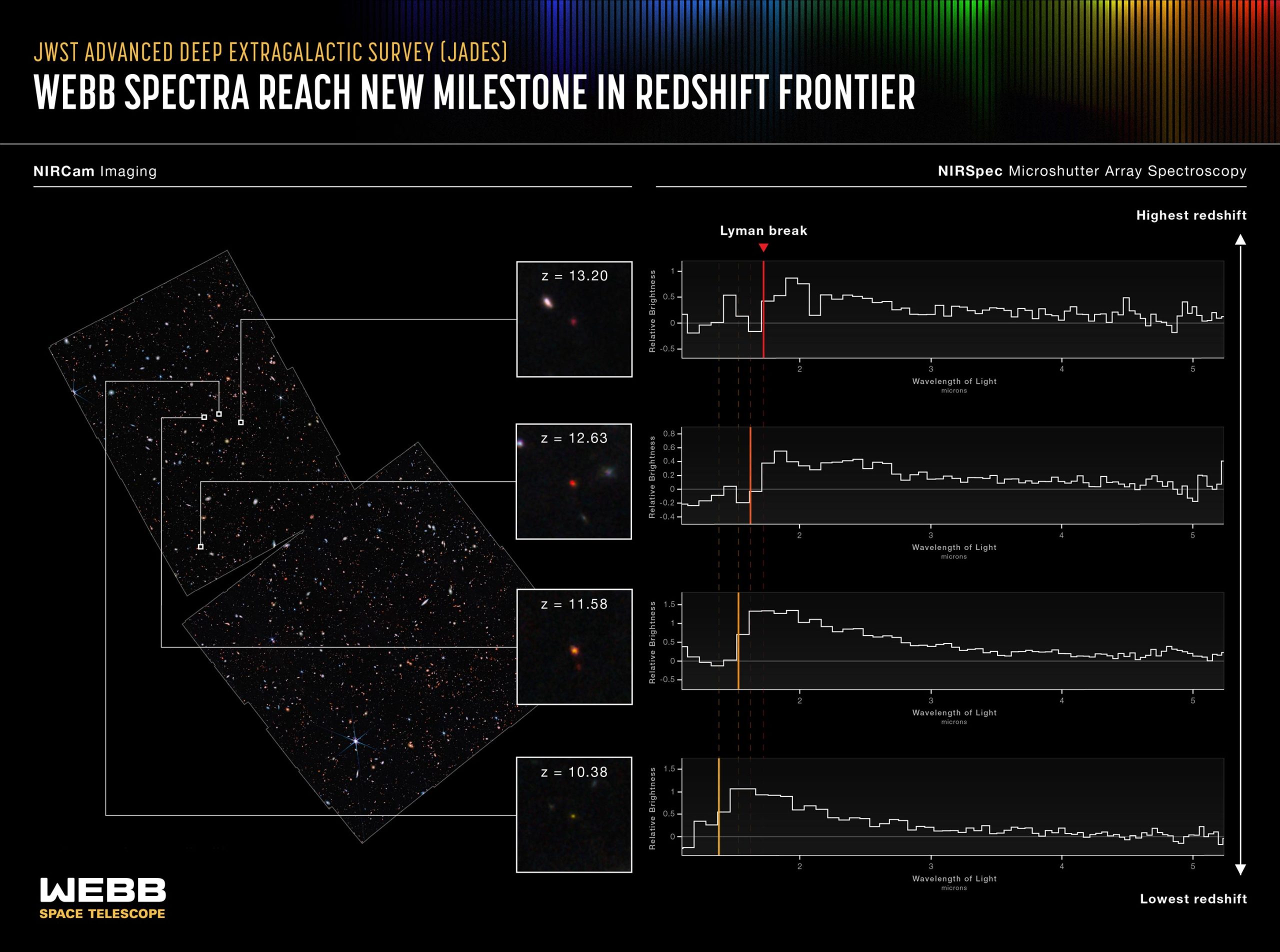
Initial observations from JWST yielded several candidate galaxies at extreme distances, as had earlier observations with the Hubble Space Telescope. Now, four of these targets have been confirmed by obtaining long spectroscopic observations, which not only provide secure measurements of their distances, but also allow astronomers to characterize the physical properties of the galaxies.
“We’ve discovered galaxies at fantastically early times in the distant universe,” said Brant Robertson, professor of astronomy and astrophysics at UC Santa Cruz. “With JWST, for the first time, we can now find such distant galaxies and then confirm spectroscopically that they really are that far away.”
Astronomers measure the distance to a galaxy by determining its redshift. Due to the expansion of the universe, distant objects appear to be receding from us and their light is stretched to longer, redder wavelengths by the Doppler effect. Photometric techniques based on images captured through different filters can provide redshift estimates, but definitive measurements require spectroscopy, which separates the light from an object into its component wavelengths.

The new findings focus on four galaxies with redshifts higher than 10. Two galaxies initially observed by Hubble now have confirmed redshifts of 10.38 and 11.58. The two most distant galaxies, both detected in JWST images, have redshifts of 13.20 and 12.63, making them the most distant galaxies confirmed by spectroscopy to date. A redshift of 13.2 corresponds to about 13.5 billion years ago.
“These are well beyond what we could have imagined finding before JWST,” Robertson said. “At redshift 13, the universe is only about 325 million years old.”
Robertson and Emma Curtis-Lake from the University of Hertfordshire (U.K.) are the lead authors of two papers on the results that have not yet been through the peer-review process (see links below).
The observations result from a collaboration of scientists who led the development of two of the instruments onboard Webb, the Near-Infrared Camera (NIRCam) and the Near-Infrared Spectrograph (NIRSpec). The investigation of the faintest and earliest galaxies was the leading motivation in the concepts for these instruments. In 2015, the instrument teams joined together to propose the JWST Advanced Deep Extragalactic Survey (JADES), an ambitious program that has been allocated just over one month of the telescope’s time and is designed to provide a view of the early universe unprecedented in both depth and detail. JADES is an international collaboration of more than eighty astronomers from ten countries.
“These results are the culmination of why the NIRCam and NIRSpec teams joined together to execute this observing program,” said Marcia Rieke, NIRCam principal investigator at the University of Arizona.
A Treasure Trove of Early Galaxies
The JADES program began with NIRCam, using over 10 days of mission time to observe a small patch of sky in and around the Hubble Ultra Deep Field. Astronomers have been studying this region for over 20 years with nearly all large telescopes. The JADES team observed the field in nine different infrared wavelength ranges, capturing exquisite images that reveal nearly 100,000 distant galaxies, each billions of light years away.
The team then used the NIRSpec spectrograph for a single three-day observation period to collect the light from 250 faint galaxies. This yielded precise redshift measurements and revealed the properties of the gas and stars in these galaxies.
“With these measurements, we can know the intrinsic brightness of the galaxies and figure out how many stars they have,” Robertson said. “Now we can start to really pick apart how galaxies are put together over time.”
Coauthor Sandro Tacchella from the University of Cambridge in the United Kingdom added, “It is hard to understand galaxies without understanding the initial periods of their development. Much as with humans, so much of what happens later depends on the impact of these early generations of stars. So many questions about galaxies have been waiting for the transformative opportunity of Webb, and we’re thrilled to be able to play a part in revealing this story.”
Star Formation in the Universe’s Infancy
According to Robertson, star formation in these early galaxies would have begun about 100 million years earlier than the age at which they were observed, pushing the formation of the earliest stars back to around 225 million years after the Big Bang.
“We are seeing evidence of star formation about as early as we could expect based on our models of galaxy formation,” he said.
Other teams have identified candidate galaxies at even higher redshifts based on photometric analyses of JWST images, but these have yet to be confirmed by spectroscopy. JADES will continue in 2023 with a detailed study of another field, this one centered on the iconic Hubble Deep Field, and then a return to the Ultra Deep Field for another round of deep imaging and spectroscopy. Many more candidates in the field await spectroscopic investigation, with hundreds of hours of additional time already approved.
For more on this research, see NASA’s Webb Space Telescope Discovers Earliest Galaxies in the Universe.
References:
“Identification and properties of intense star-forming galaxies at redshifts z > 10” by B. E. Robertson, S. Tacchella, B. D. Johnson, K. Hainline, L. Whitler, D. J. Eisenstein, R. Endsley, M. Rieke, D. P. Stark, S. Alberts, A. Dressler, E. Egami, R. Hausen, G. Rieke, I. Shivaei, C. C. Williams, C. N. A. Willmer, S. Arribas, N. Bonaventura, A. Bunker, A. J. Cameron, S. Carniani, S. Charlot, J. Chevallard, M. Curti, E. Curtis-Lake, F. D’Eugenio, P. Jakobsen, T. J. Looser, N. Lützgendorf, R. Maiolino, M. V. Maseda, T. Rawle, H.-W. Rix, R. Smit, H. Übler, C. Willott, J. Witstok, S. Baum, R. Bhatawdekar, K. Boyett, Z. Chen, A. de Graaff, M. Florian, J. M. Helton, R. E. Hviding, Z. Ji, N. Kumari, J. Lyu, E. Nelson, L. Sandles, A. Saxena, K. A. Suess, F. Sun, M. Topping and I. E. B. Wallace, 4 April 2023, Nature Astronomy.
arXiv:2212.04480
DOI: 10.1038/s41550-023-01921-1
“Spectroscopic confirmation of four metal-poor galaxies at z=10.3-13.2” by Emma Curtis-Lake, Stefano Carniani, Alex Cameron, Stephane Charlot, Peter Jakobsen, Roberto Maiolino, Andrew Bunker, Joris Witstok, Renske Smit, Jacopo Chevallard, Chris Willott, Pierre Ferruit, Santiago Arribas, Nina Bonaventura, Mirko Curti, Francesco D’Eugenio, Marijn Franx, Giovanna Giardino, Tobias J. Looser, Nora Lützgendorf, Michael V. Maseda, Tim Rawle, Hans-Walter Rix, Bruno Rodriguez del Pino, Hannah Übler, Marco Sirianni, Alan Dressler, Eiichi Egami, Daniel J. Eisenstein, Ryan Endsley, Kevin Hainline, Ryan Hausen, Benjamin D. Johnson, Marcia Rieke, Brant Robertson, Irene Shivaei, Daniel P. Stark, Sandro Tacchella, Christina C. Williams, Christopher N. A. Willmer, Rachana Bhatawdekar, Rebecca Bowler, Kristan Boyett, Zuyi Chen, Anna de Graaff, Jakob M. Helton, Raphael E. Hviding, Gareth C. Jones, Nimisha Kumari, Jianwei Lyu, Erica Nelson, Michele Perna, Lester Sandles, Aayush Saxena, Katherine A. Suess, Fengwu Sun, Michael W. Topping, Imaan E. B. Wallace and Lily Whitler, 8 December 2022, Astrophysics > Astrophysics of Galaxies.
arXiv:2212.04568
Never miss a breakthrough: Join the SciTechDaily newsletter.
Follow us on Google and Google News.
2 Comments
Being in my 70’s I have watched manned space flights from the beginning. I have to say this is the most fascinating thing I seen since landing on the moon in 1969. Thanks for updating us with all the information from the JWST. Hopefully I will live to see us land on Mars and also find a plant with life. Thanks and keep up the great work.
13 billion years x speed of light (157,000 mps) is an impossible distance to imagine.